
- All
- Product Name
- Product Keyword
- Product Model
- Product Summary
- Product Description
- Multi Field Search
Please Choose Your Language
Views: 0 Author: Site Editor Publish Time: 2026-08-01 Origin: Site


Packaging bottlenecks strike hard and fast in manufacturing lines. Unplanned stops disrupt production schedules and reduce your overall output significantly. Blister packaging inefficiencies directly hurt Overall Equipment Effectiveness (OEE). They lead to costly batch rejections and introduce severe compliance risks. Poorly sealed packages often result in immediate GMP or FDA regulatory violations.
We designed this guide to provide a technical troubleshooting framework for your existing equipment. You will discover practical methods to resolve feeding, forming, and sealing faults. We also provide an evaluation lens to help you determine when recurring faults justify a complete equipment upgrade. Ultimately, you will know exactly when it makes sense to invest in a modern automatic blister packing machine.
Micro-stops rapidly erode production margins. Operators often clear minor jams without logging the downtime. These undocumented pauses accumulate over a shift. A machine stopping for just two minutes every hour results in massive yield losses over a fiscal year. A struggling Blister Packing Machine drives up labor costs while decreasing throughput.
You must define acceptable baseline metrics to measure success accurately. Industry standards suggest aiming for specific targets. Maintain machine uptime above 95 percent. Keep material scrap rates strictly below 1 percent. Ensure tool changeovers happen in under 30 minutes. If your equipment fails these metrics, you are losing money daily.
Compromised barrier integrity creates severe compliance risks. Pharmaceutical and food products require strict moisture and oxygen barriers. Micro-leaks shorten product shelf-life and risk patient safety. Regulatory bodies like the FDA conduct rigorous audits. Failing to document and fix packaging integrity issues can lead to immediate batch recalls and severe penalties.
Consider the following operational benchmarks when evaluating your line:
Blister pockets sometimes form unevenly or thin out at the corners. Material jamming during the feeding phase is another frequent headache. These issues waste expensive forming films and disrupt downstream packaging stations.
Technical realities usually point to two root causes. First, incorrect index settings or improper roller tension throw off the entire synchronization. Second, fluctuating heating plate temperatures ruin material integrity. If the plates run too hot, the material melts and thins out. If they run too cold, the film becomes brittle and tears during forming.
You can deploy several tactical solutions to fix these errors. Recalibrate your servo-drives to ensure precise index matching. Implement regular thermal mapping across the heating station. You must verify that the temperature remains uniform across the entire plate surface.
Common Mistakes to Avoid:
When evaluating older equipment, note how legacy mechanical cams struggle to maintain consistent tension. Mechanical chains stretch over time. This stretching introduces micro-variations in the feeding phase. Modern servo-driven feeding systems handle these adjustments digitally. They eliminate physical wear issues entirely.
| Forming Failure Symptom | Probable Root Cause | Immediate Action Step |
|---|---|---|
| Web tracking off-center | Misaligned feeding rollers | Use a machinist level to square all guide rollers. |
| Thinning blister corners | Excessive heat or fast plug-assist | Reduce plate temperature by 2-5°C and slow plug speed. |
| Material snapping | Insufficient pre-heating | Increase dwell time in the heating zone. |
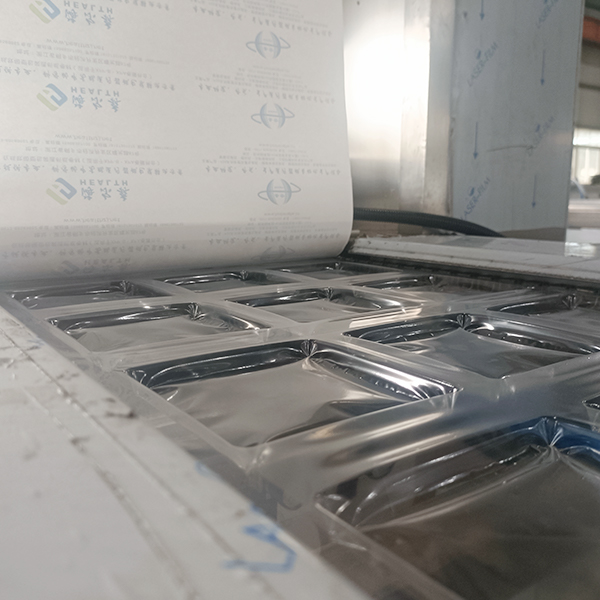
Incomplete seals compromise your entire product batch. You might notice skewed knurling patterns or detect micro-leaks in the finished blister card during vacuum testing. These integrity failures are critical quality events.
Uneven pressure distribution across the sealing cylinder is a primary culprit. Over millions of cycles, pneumatic cylinders wear down unevenly. Degraded or improperly machined sealing molds also cause weak spots. Furthermore, foil register misalignment means the lidding foil does not match the formed pockets perfectly.
To fix this, verify your pneumatic pressure gauges immediately. Replace worn cylinder seals during your next preventive maintenance window. You can also utilize carbon paper testing. Place carbon paper between the upper and lower sealing dies. Cycle the machine without product. Inspect the paper for light spots to easily identify uneven pressure zones.
High-quality modern machines utilize localized pressure regulation. They rely on automated foil registration driven by photoelectric sensors. This technology eliminates the manual guesswork involved in matching print registers to formed pockets.
Rough edges and curled blister cards indicate problems at the final punching station. Misalignment here means good product gets destroyed right before cartoning. It is a frustrating and expensive point of failure.
Dull cutting tools routinely cause this problem. Incorrect punch clearances also create burrs and curled edges. Over time, desynchronization occurs between the pulling mechanism and the cutting station. The indexer pulls the web slightly too far, or not far enough.
Implement a strict tool-sharpening schedule. Do not wait for bad cuts to replace your dies. Check punch clearances regularly using feeler gauges. If the machine drifts, reset the timing belt or re-zero the encoder on the main drive.
Constant desynchronization presents a massive implementation risk. It often points to severe main drive wear. Rebuilding mechanical main drives repeatedly is highly cost-prohibitive. If your maintenance team constantly chases timing issues, the machine's core mechanics are likely failing.
Knowing when to stop repairing and start replacing is a critical engineering decision. You must objectively measure if your packaging equipment is beyond economical repair. Emotional attachments to older, familiar machines often cloud this judgment.
You need to calculate the true cost of ongoing failures. Track your downtime hours. Sum up the cost of rejected materials. Add the invoice totals for spare parts over a rolling 12-month period. If these combined expenses exceed 15 to 20 percent of a new machine's purchase price, replacement is the financially sound choice.
Operational risk increases drastically with older machines. Relying on outdated PLCs is dangerous. Original manufacturers eventually stop supporting proprietary electronic parts. If a legacy control board burns out and no replacements exist, your production line halts indefinitely.
Conduct a thorough OEE audit this month. If your machine availability drops below 80% strictly due to mechanical faults, take action immediately. Begin the shortlisting process for new equipment before a catastrophic breakdown forces an emergency purchase.
Sourcing new equipment requires a strategic approach. You must map technical features directly to production outcomes. Do not buy features you do not need, but do not compromise on core technologies.
Modern servo-driven technology is non-negotiable. It eliminates mechanical chain stretch completely. This ensures perfect synchronization and drastically lowers scrap rates. Tool-less changeovers are equally critical. This feature reduces setup time from hours to mere minutes. It supports modern high-mix, low-volume production schedules perfectly.
Advanced HMI and PLC integrations make your operators highly effective. Self-diagnostic error codes simplify troubleshooting. Instead of guessing why the machine stopped, the operator reads the exact sensor fault on the touch screen.
| Modern Feature | Technical Capability | Business Outcome |
|---|---|---|
| Servo-Driven Indexing | Digital axis control without mechanical chains | Zero chain stretch; near-zero feeding scrap. |
| Tool-less Changeovers | Quick-release pins and magnetic locks | Reduces batch setup time by up to 80%. |
| Advanced HMI Diagnostics | Real-time sensor monitoring and error logging | Reduces troubleshooting time; minimizes MTTR. |
Scalability and compliance must drive your purchasing criteria. Look for robust software that complies with 21 CFR Part 11. You need secure audit trails and electronic signatures for pharmaceutical validation. Demand modular designs to allow for future serialization integrations.
Examine the physical construction closely. Strict GMP-compliant construction is mandatory. You want a clear physical separation between the mechanical drive zones and the clean packaging zones. High-grade 304 or 316L stainless steel prevents contamination and withstands aggressive cleaning agents.
Finally, assess vendor trustworthiness. Require transparent Factory Acceptance Testing (FAT) protocols. Ensure they provide a clear checklist of what will be tested before the machine leaves their facility. Demand localized aftermarket support guarantees so you never wait weeks for critical replacement parts.
Tactical troubleshooting resolves your immediate production bottlenecks. Recalibrating sensors and replacing worn seals will keep your lines running today. However, systemic issues require a deeper capital investment strategy. When mechanical wear affects your bottom line continuously, patching the problem is no longer viable.
A modern automatic blister packing machine acts as a powerful investment in risk mitigation. It optimizes yield, ensures regulatory compliance, and protects your brand reputation. Transitioning from reactive maintenance to proactive equipment upgrades gives you a massive competitive advantage.
Take action on your production floor this week. Download an equipment evaluation checklist to standardize your reviews. Calculate your current OEE metrics over the last thirty days. Consult with an internal packaging engineer to conduct a comprehensive machine audit.
A: Weak seals usually result from temperature and pressure misalignments. Uneven pressure across the pneumatic cylinder prevents uniform bonding. Worn or degraded sealing dies also create cold spots. Always check your pressure gauges and perform a carbon paper test to ensure even die contact.
A: Tooling lifespan depends on cycle counts and material abrasiveness. Aluminum forming requires more frequent tool changes than PVC. Generally, inspect dies every 500,000 cycles. Replace them when you notice burrs, scoring, or when clearance tolerances exceed manufacturer specifications during your preventative maintenance checks.
A: Yes, you can retrofit basic sensors. However, older machines still rely on mechanical chains and cams. Sensors will detect errors but cannot fix mechanical slop or chain stretch. Purchasing a fully integrated servo-driven machine offers a much higher return on investment through superior precision.
A: You should use a vacuum leak tester. Submerge the finished blister pack in a chamber filled with water and methylene blue dye. Apply a vacuum. If the seal is weak, the vacuum pulls the colored dye into the pocket, making visual identification of micro-leaks easy.


