
- All
- Product Name
- Product Keyword
- Product Model
- Product Summary
- Product Description
- Multi Field Search
Please Choose Your Language
Views: 0 Author: Site Editor Publish Time: 2026-07-31 Origin: Site


Purchasing a Blister Packing Machine represents a critical capital expenditure. This decision directly impacts production efficiency, product integrity, and strict industry compliance. We define this equipment objectively. It is an automated or semi-automated system designed to form cavities, fill them, and seal them. Operators use them to package unit-dose products like solid dosage pharmaceuticals, medical devices, or everyday consumer goods. A backing material secures the contents safely inside. Our purpose here moves past basic definitions. We want to provide production managers and purchasing agents a highly practical, vendor-neutral framework. You will learn exactly how to evaluate, shortlist, and implement blister packaging equipment effectively. This guide breaks down operational sequences, equipment categories, and vital compliance requirements. We will equip you to make a confident, data-driven buying decision.
Scalability Dictates Selection: The choice between manual, semi-automatic, and fully automatic machines hinges on specific batch sizes, format changeover frequency, and labor costs.
Material Flexibility Matters: Not all machines handle both thermoforming (PVC/PVDC) and cold-forming (Alu/Alu) efficiently; specialized tooling is required.
Compliance is Non-Negotiable: For pharmaceutical applications, GMP design, validatable software, and integrated vision inspection systems are mandatory baseline requirements.
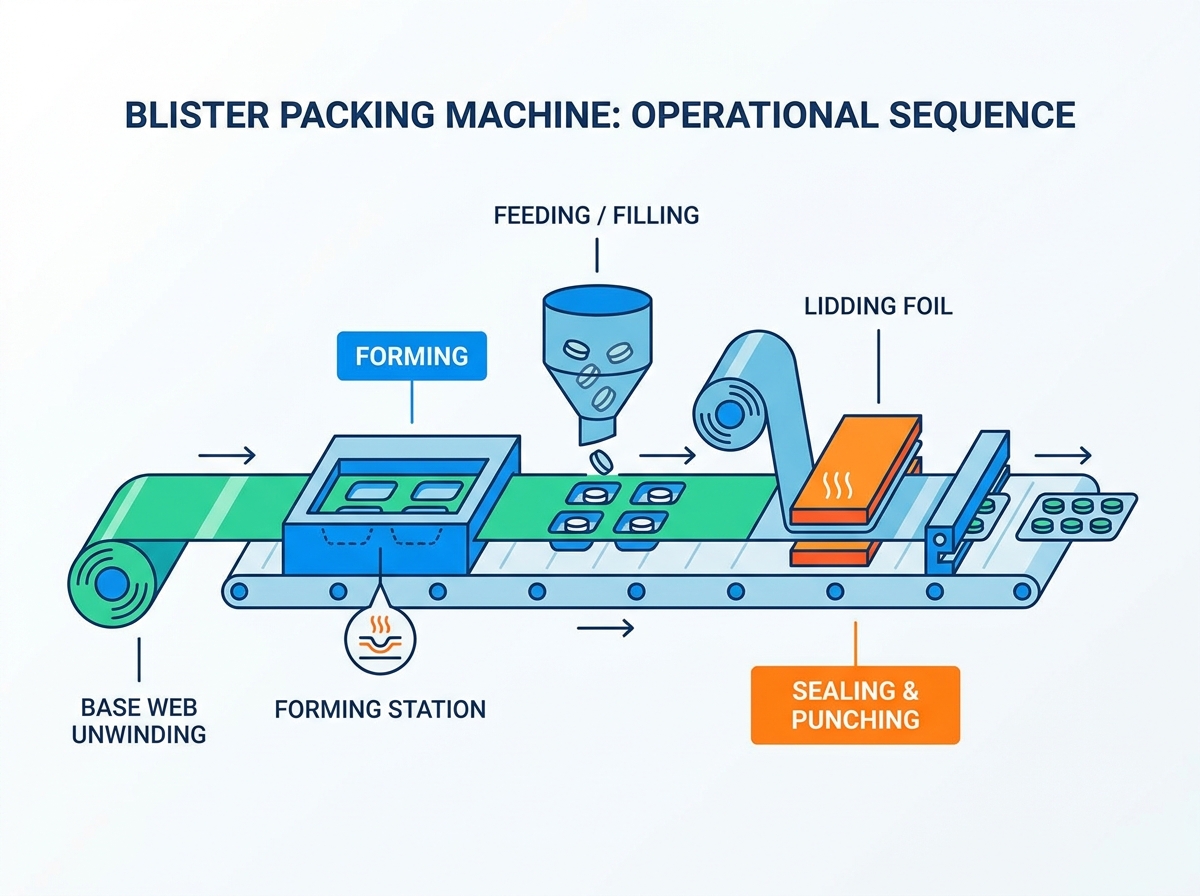
Understanding the technical baseline prevents costly procurement mistakes. We will explore the primary stages briefly.
Base film rolls feed directly into the system. Servo motors unwind this plastic film precisely. The film enters a dedicated heating station. Heating plates warm the material to a pliable state. Operators must control this temperature accurately. Excessive heat melts the film entirely. Insufficient heat prevents proper cavity formation.
You need uniform heat distribution across the entire web width. Modern machines utilize zoned heating plates. These plates allow micro-adjustments across different sections. This ensures consistent pliability before the film reaches the molds.
This station shapes the heated film or cold-forming foil. We must differentiate between the two main methods.
Thermoforming: This process uses compressed air or plug-assist mechanisms. Compressed air pushes the softened plastic into a mold. Plug-assist uses mechanical Teflon plugs before applying air. This ensures uniform wall thickness for deep cavities.
Cold-Forming: This method handles sensitive materials like aluminum. It relies entirely on mechanical stamping. Solid Teflon stamps press the aluminum into the die.
Stretching aluminum requires extreme precision. Minor alignment errors cause micro-fractures in the foil. These fractures ruin the moisture barrier completely.
Filling speed usually dictates your entire line speed. An automated hopper system releases the product. The product travels into a designated feeder box. You will encounter different feeder types based on your product. Brush boxes sweep standard tablets into the formed cavities. Dedicated tube feeders drop oblong capsules individually. Complex geometries require specialized vibratory bowl feeders. A highly efficient Blister Packing Machine syncs the feeder precisely to the web speed.
Best Practice: Always test your exact tablet shapes in the vendor's feeders before finalizing a purchase.
Lidding foil meets the filled base web here. Heated sealing rollers or flat platen plates apply pressure. This action bonds the two materials together permanently. The heat activates a specific lacquer coating on the lidding foil. The sealed web then indexes forward into the punching station. Precision dies cut individual blister cards from the continuous web. Good machine design minimizes the skeletal web waste left behind. The machine then ejects the finished cards onto a discharge conveyor.
We categorize these solutions to help buyers identify their appropriate tier. Choosing the wrong scale wastes capital.
These small units fit easily on a standard laboratory table. Operators manually place the base film. They fill cavities by hand. Finally, they pull down a sealing handle manually.
Best for: R&D labs, clinical trials, or very low-volume specialty runs.
Reality Check: They remain highly labor-intensive. You will find it difficult to guarantee consistent seal pressure and temperature at scale. Human operators experience physical fatigue. This fatigue leads to variable seal quality over an eight-hour shift. They cannot support commercial production volumes.
These machines automate the core forming and sealing steps. Operators usually assist in the filling or transfer processes.
Best for: Mid-sized contract packaging organizations (CPOs). Facilities dealing with frequent, small-batch format changes also benefit immensely.
Reality Check: This equipment strikes a solid balance between cost and automation. However, it relies heavily on operator pacing for throughput. If your operator slows down, the entire line slows down. You still need dedicated personnel monitoring the feeding stage constantly.
These robust systems handle the entire process without manual intervention. They unwind, form, feed, seal, punch, and eject automatically.
Best for: High-volume commercial pharmaceutical manufacturing.
Reality Check: They require a significant upfront investment. You need a dedicated facility footprint. You also need highly skilled maintenance teams. Manufacturers often integrate them directly with cartoning machines downstream. This integration requires complex software synchronization.
Machine Tier | Target Environment | Automation Level | Primary Limitation |
|---|---|---|---|
Manual/Benchtop | R&D Labs, Clinical Trials | Low | Operator Fatigue, Low Yield |
Semi-Automatic | Mid-sized CPOs, Small Batches | Medium | Operator Pacing Dependency |
Fully Automatic | Commercial Pharma Manufacturing | High | High Capital Investment |
How do you evaluate different vendors effectively? Use this strategic framework to shortlist your options.
Many buyers obsess over "blisters per minute" (BPM). You must evaluate capacity using Overall Equipment Effectiveness (OEE) instead. High top speeds mean nothing during excessive downtime. Frequent format changeovers destroy theoretical daily yields. A machine running steadily at 200 BPM often outperforms a 400 BPM machine suffering from constant micro-stops. Check how the machine handles minor jams.
Common Mistake: Buying excess capacity without calculating actual changeover frequency. You waste money on speed you never utilize fully.
You must assess supported materials carefully. Ensure your chosen Blister Packing Machine handles your required films.
Consider these popular materials:
PVC: Standard, cost-effective thermoforming film used widely.
PVDC: Offers better moisture barriers for sensitive products.
Aclar: Premium transparent high-barrier film requiring precise heat control.
Alu/Alu: Complete moisture and light barrier using cold forming.
Note: Cold forming aluminum requires a much larger machinery footprint. The mechanics involve stretching aluminum gradually without rupturing it. The die stations need significantly more space compared to simple heat stations.
Fast changeovers define modern manufacturing success. Look specifically for tool-less changeover features. Operators should use quick-release levers instead of heavy wrenches. Evaluate the cost of purchasing new format parts. Find out the vendor lead time for these parts. Product lines change frequently in agile facilities. You do not want a three-month delay waiting for a new cutting die. Modular designs allow you to swap entire feeding stations quickly.
Quality control must happen inline automatically. Relying on manual inspection invites product recalls. Must-have features include specific detection systems. Pinhole detection is mandatory for Alu/Alu packaging. A tiny fracture ruins the product shelf life instantly. Integrated camera systems verify missing or broken products. These vision systems communicate directly to the PLC. Automated rejection mechanisms then discard faulty blisters before they reach the cartoner.
Frame the financial and operational benefits clearly. Upgrading to advanced automation transforms your operational bottom line.
Fully automated feeding systems drastically reduce headcount on the packaging line. Manual filling requires multiple operators standing beside a conveyor. Automated robotic feeders replace them completely. Cartoning integration removes even more manual handling. A modern line transfers sealed blisters directly into folding cartons. This continuous flow allows a single technician to manage the entire process. You repurpose displaced staff to higher-value tasks elsewhere in the facility.
Material costs add up quickly over a fiscal year. Modern servo-driven indexing reduces web edge waste significantly. Older mechanical machines leave wide margins between blister cards. Servo motors position the web with exact millimeter accuracy. This precision allows die-cutters to punch closer together. You maximize the number of cards per roll. Furthermore, automated rejection only discards the specific faulty blister. It minimizes rejected sheets and saves good product.
Product recalls destroy brand reputation overnight. They also incur massive financial penalties from regulatory bodies. Automated verification reduces the risk of expensive recalls. Vision systems catch empty pockets instantly during production. Sensor arrays detect compromised seals before shipping. You remove human error from the quality control loop entirely. Regulators view automated inspection highly during routine facility audits. Robust risk mitigation justifies the initial capital expenditure rapidly.
Demonstrate real-world experience by addressing what usually goes wrong. Implementing heavy machinery requires meticulous planning and foresight.
Pharmaceutical applications demand strict baseline requirements. The equipment must meet Good Manufacturing Practice (GMP) standards strictly. Look for cleanroom compatibility features. The machine design needs sloped surfaces everywhere. Sloped surfaces prevent dust accumulation and simplify washdowns. Software compliance is equally critical for regulated markets. The operating system must comply fully with 21 CFR Part 11. This requires secure user logins. It also demands unalterable digital audit trails for every parameter change.
Buyers often overlook physical facility limits during procurement. You must factor in utility requirements early. A robust Blister Packing Machine consumes high volumes of compressed air. It requires dedicated chilling systems for the cooling plates. Verify your electrical power drops beforehand. Check your physical floor space carefully. Inline blister-to-carton systems stretch quite long. You need adequate clearance around the machine for maintenance access and material loading.
Never skip the FAT process. You must demand rigorous FAT at the vendor facility. Run the machine using your exact products. Use your actual production packaging materials. Do not rely on dummy placebos or substitute films. Discovering a feeding issue on your production floor is a disaster. The FAT ensures the equipment meets every specification before shipping. Document every test result formally before signing off.
Selecting the right blister packaging equipment requires careful balance. You must weigh immediate budget constraints against long-term format flexibility. Compliance needs remain paramount throughout this entire buying process. We recommend taking proactive next steps immediately. First, audit your current product portfolio comprehensively. Next, calculate your average batch sizes accurately. Finally, prepare a highly detailed User Requirement Specification (URS). A solid URS protects your investment thoroughly. Complete this document before engaging any vendors for quotes.
A: Alu/Alu uses mechanical cold forming to stretch aluminum foil into cavities. This requires specialized mechanical tooling and specific pinhole detection sensors. PVC machines use heat thermoforming to soften plastic before shaping it with compressed air. Cold forming machines are generally larger and more complex.
A: A format changeover on a modern, modular blister machine typically takes between 15 and 45 minutes. These systems feature tool-less mechanisms and quick-release levers. In contrast, legacy equipment often requires several hours and dedicated mechanical tools to change molds and die-cutters.
A: Theoretically, yes, if the machine has deep-draw forming capabilities. However, manufacturers usually prefer dedicated machines for each product type. Mixing pharmaceuticals and medical devices on one line creates severe cross-contamination risks. It also complicates cleaning validation procedures required by regulatory bodies.
A: Buyers should set realistic expectations for delivery. The typical lead time ranges from 4 to 8 months. This timeline depends heavily on the level of customization, current vendor production backlog, and the complexity of the Factory Acceptance Testing (FAT) requirements.

