
- All
- Product Name
- Product Keyword
- Product Model
- Product Summary
- Product Description
- Multi Field Search
Please Choose Your Language
Views: 0 Author: Site Editor Publish Time: 2026-07-10 Origin: Site


Understanding the operational process of a Blister Packing Machine is critical for assessing production throughput and material compatibility. You also need this knowledge to gauge overall equipment effectiveness accurately. Poorly evaluated equipment often leads to compromised seal integrity on the production line. It causes high reject rates and triggers severe GMP compliance failures in pharmaceutical or food packaging facilities. You simply cannot afford these operational bottlenecks in strictly regulated environments. This comprehensive guide breaks down the core operational sequence phase by phase. We will explore material-specific process variations like thermoforming and cold forming. You will also discover critical evaluation criteria to help process engineers and procurement teams shortlist the right equipment. By the end, you will know exactly how to evaluate machine mechanics and ensure reliable daily operation.
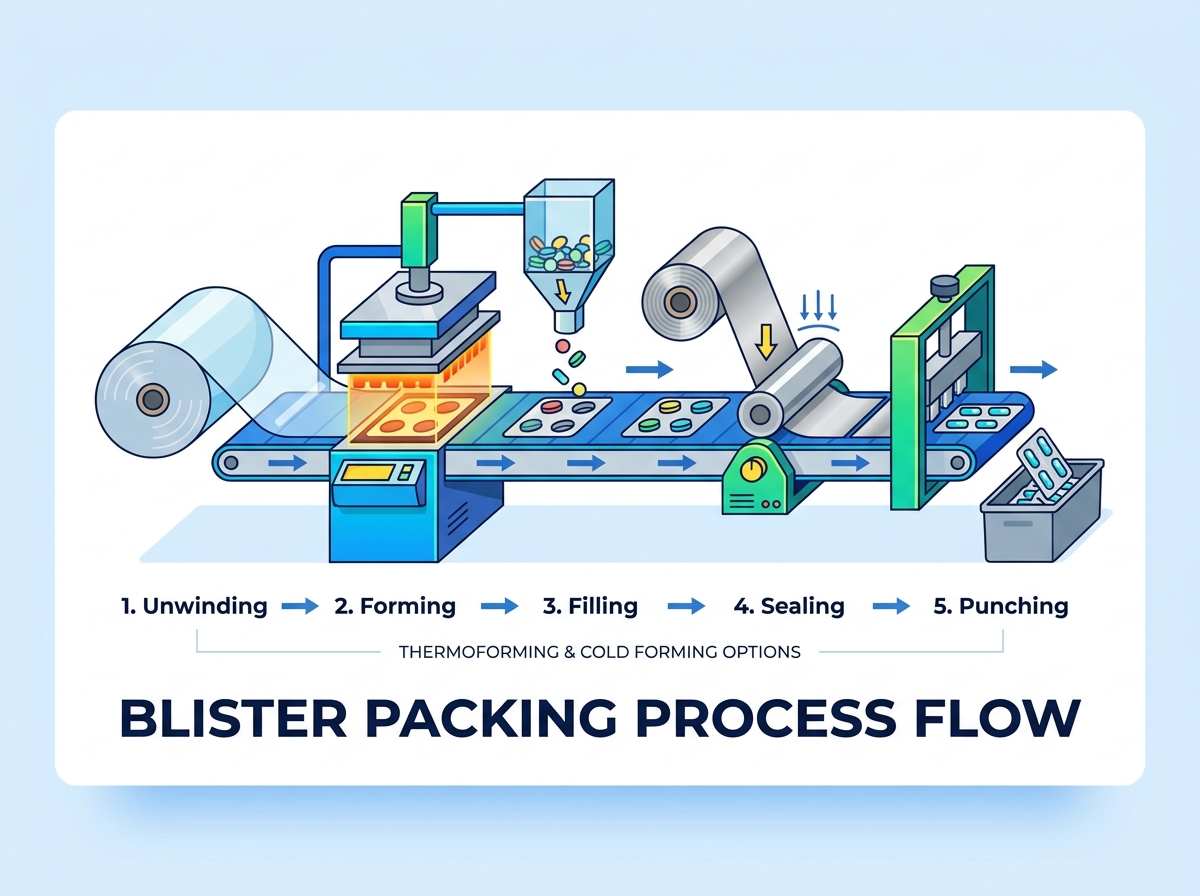
The operation revolves around five synchronized phases: Unwinding, Forming, Filling, Sealing, and Punching/Cutting.
Process mechanics vary significantly based on material choice, notably between Thermoforming (heat-reliant) and Cold Forming (pressure-reliant Alu-Alu).
Evaluating a blister packing machine requires scrutinizing its heat distribution precision, tooling changeover speed, and integrated inspection systems.
Successful implementation demands strict alignment with standard operating procedures (SOPs) and Good Manufacturing Practices (GMP) to mitigate risks like micro-leaks and cross-contamination.
Every successful packaging run relies on a precise sequence of events. A modern Blister Packing Machine links multiple complex mechanisms. They work together seamlessly to protect sensitive products. We can divide this operation into five core phases.
The machine begins by pulling the base forming film from a heavy roll. This film often consists of PVC, PET, or specialized aluminum. Servo motors control the release rate carefully. They maintain consistent web tension across the entire line. Splicing tables and tension rollers play crucial roles here. They prevent material misalignment during continuous operation. Misaligned films cause devastating jam-ups downstream. Advanced systems also include splice detectors. These sensors track the taped joints where two raw material rolls meet. They signal the rejection station to discard any blisters containing spliced material automatically.
Next, the web enters the forming station. This step defines the blister pocket shape.
Thermoforming: Plastic films require heat. The machine pre-heats the material to its softening point. This temperature usually ranges between 120°C and 140°C. Compressed air or mechanical plugs then push into the softened plastic. They form precise cavities quickly.
Cold Forming: Aluminum foil cannot stretch via heat. Machines use mechanical stamps to press cavities into the solid metal. This cold forming requires strict pressure calibration. Without precise calibration, the foil suffers micro-tearing.
Once cavities exist, the machine must fill them. Automated feeders deposit tablets or capsules directly into the empty pockets. Engineers use dedicated brush, vibratory, or planetary feeders. The choice depends entirely on product shape and fragility. Rotary brushes gently sweep capsules into cavities while clearing excess dust. Vibratory tracks align irregularly shaped tablets perfectly. Vision inspection systems scan the web immediately after filling. High-speed cameras detect empty cavities or broken products instantly.
The loaded web moves forward to meet the lidding material. Manufacturers typically use aluminum foil coated in a heat-seal lacquer. The sealing station applies precise heat and pressure. Dwell time determines how long the sealing plates contact the material. Rotary cylinders use a continuous rolling motion for high speeds. Platen plates press down intermittently for stronger, longer-duration seals.
The final phase involves marking and cutting. Embossing units print lot numbers and expiration dates onto the sealed web. Tracking codes go on next for strict supply chain visibility. High-precision punching dies then cut the continuous web. They separate valid, individual blister cards. The machine diverts any flawed units into a centralized rejection bin automatically.
Material choices dictate machine mechanics. Your operational baseline changes completely depending on your barrier requirements.
Plastic-based operations rely heavily on temperature zoning. The machine must heat the film rapidly and cool it efficiently. Thermoforming fits perfectly for high-speed runs. It enables straightforward visual inspection because the plastic remains transparent. However, it offers lower barrier protection against moisture and light. You must monitor cooling plates closely. If the plastic stays too warm, it warps during the sealing phase.
Processing solid aluminum eliminates the heating station entirely. Cold forming relies exclusively on immense mechanical pressure. Because aluminum foil does not stretch like plastic, it draws material from surrounding areas. This geometric limitation demands a larger machine footprint. The equipment spaces cavities further apart. Operational speeds drop significantly compared to thermoforming. You also face higher raw material usage. Despite these drawbacks, cold forming provides an absolute barrier. It remains strictly necessary for highly sensitive pharmaceutical compounds.
You must ensure your chosen machine format aligns strictly with your product stability profile. Do not force sensitive hygroscopic drugs into standard PVC thermoformed packs. Match the packaging method to the chemical reality of your compound. Review the structural comparison below to map out these core differences effectively.
Process Variable | Thermoforming (Plastic/Alu) | Cold Forming (Alu/Alu) |
|---|---|---|
Primary Mechanism | Heat softening and compressed air | Mechanical stamping under high pressure |
Production Speed | High (Continuous motion suitable) | Moderate to Low (Intermittent motion required) |
Barrier Protection | Low to Medium | Maximum (100% moisture and light barrier) |
Inspection Complexity | Low (Transparent base allows easy scanning) | High (Opaque base requires advanced vision logic) |
Footprint Requirements | Compact cavity spacing | Wide cavity spacing requiring larger footprint |
Regulatory bodies demand absolute precision in pharmaceutical and food packaging. Good Manufacturing Practices (GMP) require strictly controlled machine environments. You must evaluate how the equipment handles data and physical isolation.
Modern equipment must log critical process parameters (CPP) in real-time. These parameters include sealing pressure, forming temperature, and motor speeds. An integrated Blister Packing Machine records these metrics directly into secure databases. This traceability complies explicitly with FDA 21 CFR Part 11 regulations. It prevents unauthorized operators from altering batch records. You can audit production runs accurately during rigorous quality investigations.
Flawed packs will occasionally occur. The process must physically isolate defective packs without requiring a full machine stoppage. Quality systems flag unsealed edges, missing products, or illegible batch codes. The machine utilizes a shift-register tracking system. This system remembers the exact position of the bad blister across multiple subsequent stations. Once the web reaches the punching die, the machine diverts the specific bad card into a locked reject bin. You should also assess the sensitivity of integrated pinhole detectors. They catch microscopic tears in cold-formed aluminum before sealing even occurs.
Contamination ruins batches and triggers massive product recalls. Evaluators look for robust sanitary design elements. The best machines enforce strict separation between drive mechanisms and operational zones. Engineers place motors, gears, and lubricated parts in the rear cabinet. The actual packaging and product feeding happen in the front zone. This balcony-style design prevents particulate contamination from moving parts. It also drastically simplifies your facility's cleaning standard operating procedures (SOPs). Operators can access all product-contact surfaces instantly without dismantling heavy drive components.
Deploying complex packaging lines introduces specific operational risks. Process engineers must anticipate mechanical friction and human error. Identifying these issues early prevents chronic downtime.
Facilities rarely package a single product forever. A complex changeover process easily causes excessive downtime. When operators spend hours swapping out forming molds and sealing plates, productivity plummets. You should evaluate machines featuring tool-less, quick-change capabilities. Poka-yoke error-proofing designs prevent staff from installing molds incorrectly. Efficient tooling designs minimize format changeover times significantly.
Plastic films behave unpredictably under thermal stress. Poor tension control during the cooling phase causes severe web shrinkage. When the material shrinks, it misaligns the subsequent sealing and cutting stations. The printed lidding foil will not line up correctly. You end up slicing through the actual pill pockets. Upgraded servo-driven tension rollers resolve this issue. They compensate for micro-shrinkage dynamically to keep the web perfectly straight.
Older equipment relies heavily on manual adjustments. Operators turn hand-cranks to adjust sealing pressure or web alignment. Highly manual calibration requirements increase the risk of batch inconsistencies. One operator might run the machine differently than another. Standardizing operations via an advanced Human-Machine Interface (HMI) mitigates this risk. Recipe management systems let you save exact operational parameters. The operator simply selects the product name, and the machine calibrates itself.
Procurement teams face dozens of machine variations. Selecting the right unit requires mapping your production goals against specific machine capabilities.
High-volume, single-product facilities prioritize raw speed. They benefit immensely from rotary-sealing continuous motion machines. These machines run fast and rarely stop. Conversely, contract manufacturing organizations handle multiple client products weekly. They require platen-sealing intermittent motion machines. These units prioritize rapid format changes over maximum throughput.
Assess your scale before demanding full automation. Lab-scale or R&D environments rarely need massive production lines. They require manual or semi-automatic desktop units for clinical trials. These smaller machines validate blister formats efficiently. Commercial production demands fully automated lines. You must integrate these large machines directly into downstream cartoning machines.
Do not buy equipment based on brochures alone. Request Factory Acceptance Testing (FAT) documentation from your shortlisted vendors. Review their testing protocols thoroughly. Furthermore, you must run intensive material trials. Use your specific forming film and product. Validate the sealing integrity at maximum rated machine speeds. Machines often run perfectly at half-speed but fail under maximum thermal load.
The entire blister packing machine process represents a delicate balance of web tension, zone temperature, mechanical pressure, and precise timing. Mastering these variables ensures consistent product protection and high throughput output. When finalizing your equipment selection, keep these final action-oriented steps in mind:
Base your final procurement decision on verifiable process stability rather than advertised maximum speed alone.
Ensure the equipment includes comprehensive GMP compliance features, particularly FDA 21 CFR Part 11 data logging.
Verify the machine's ability to seamlessly execute your facility's exact standard operating procedures (SOPs).
Prioritize balcony-style sanitary designs to eliminate cross-contamination risks and streamline rapid cleaning.
Demand physical material trials before finalizing any purchase to confirm actual seal integrity.
By scrutinizing these operational details, you protect your production line from chronic downtime and costly compliance failures.
A: Rotary sealing uses heated cylinders to press the lidding foil against the base web continuously. This enables very high speeds suitable for thermoforming. Platen sealing uses flat plates pressing down intermittently. It provides longer dwell times and higher pressure, making it ideal for cold-forming aluminum and complex cavities.
A: Modern operational standards expect rapid turnarounds. On advanced equipment featuring tool-less, quick-change parts, a complete format changeover typically takes 30 to 45 minutes. Older machines lacking error-proofing designs often take several hours, as they require intensive manual recalibration and mechanical adjustments.
A: Yes, hybrid combination machines exist to handle both materials. However, switching between them requires significant mechanical intervention. Operators must swap out heating stations, forming molds, and feeding mechanisms. It also demands extensive parameter recalibration via the HMI, meaning it is not a fast, on-the-fly adjustment.

