
- All
- Product Name
- Product Keyword
- Product Model
- Product Summary
- Product Description
- Multi Field Search
Please Choose Your Language
Views: 0 Author: Site Editor Publish Time: 2026-07-17 Origin: Site


Selecting pharmaceutical packaging equipment represents a high-stakes capital expenditure for any modern production facility. The stakes remain incredibly high when product integrity is on the line. A rushed or uninformed equipment choice inevitably leads to frustrating waste ratios. It also triggers severe regulatory non-compliance issues with strict agencies like the FDA or EMA. Worse, poorly matched equipment forces unacceptable downtime during critical format changeovers. You need clarity before making such a massive financial commitment.
This guide breaks down the core mechanical principles to directly inform your buying criteria. We will examine how different forming mechanisms impact your daily operations. Then, we provide an objective breakdown of the top global manufacturers operating today. This structured approach helps you streamline your vendor shortlisting process. Ultimately, you will learn how to secure the ideal Blister Packing Machine for your specific production environment.
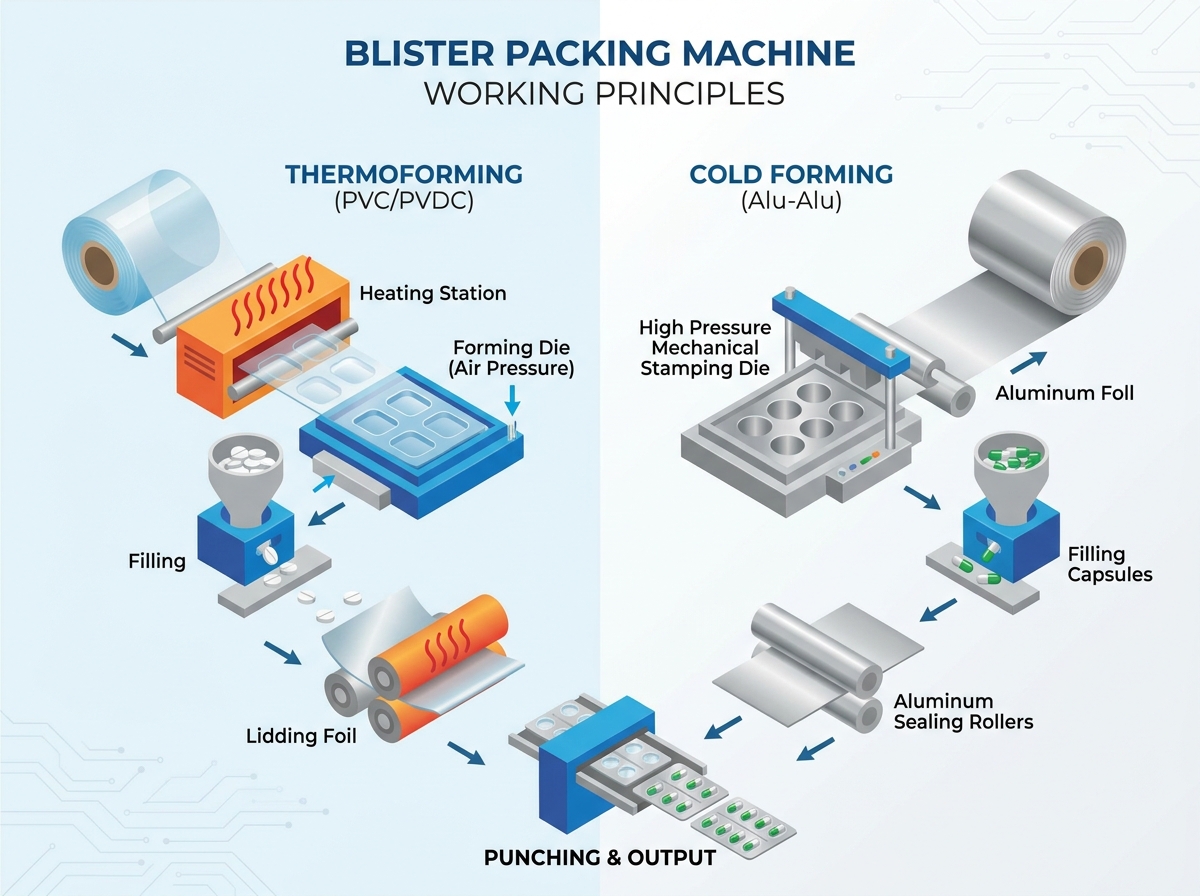
The working principle of blister packaging dictates your machine requirements: choosing between thermoforming (PVC/PVDC) and cold forming (Alu-Alu) fundamentally shifts your equipment needs.
Evaluating manufacturers requires looking past throughput claims to assess OEE (Overall Equipment Effectiveness), changeover times, and local aftermarket support.
The top-tier manufacturers are categorized by their strengths: high-volume continuous motion, agile batch flexibility, and specialized pharma compliance.
Hidden TCO (Total Cost of Ownership) often lies in custom tooling, validation documentation (IQ/OQ/PQ), and operator training.
Modern equipment typically utilizes a continuous motion or a balcony-style mechanical process. Balcony designs separate the drive mechanisms from the operating zones. This separation prevents mechanical debris from entering the packaging area. Good sanitary design ensures easier cleaning and faster clearances between production batches. Understanding each sequential phase helps you evaluate mechanical quality.
The process begins at the reel. Driven rollers pull the base web material into the primary machine zone. Common base materials include PVC, PET, or multi-layer Aluminum laminates. You must maintain precise tension during this stage.
Evaluation check: Look closely for automated splicing mechanisms. Advanced tension control systems minimize material stretching. Less material stress directly translates to fewer machine jams. These features drastically reduce the need for constant operator intervention.
Forming creates the actual cavity holding your product. The mechanism depends entirely on your chosen material. Thermoforming uses heat and pneumatic or mechanical pressing to shape plastics. Cold forming relies on high-pressure stamping to mold aluminum without using heat.
Evaluation check: Pay attention to heating zone consistency on thermoforming units. Inconsistent heat causes wall-thinning in the plastic cavities. Thin walls eventually lead to barrier failure. For cold forming, verify the stamping pressure uniformity across the entire web width.
Comparison: Thermoforming and Cold Forming Processes
Process Feature | Thermoforming (PVC/PVDC) | Cold Forming (Alu-Alu) |
|---|---|---|
Forming Mechanism | Heat application followed by air/mechanical pressure | High-pressure mechanical stamping (no heat) |
Barrier Protection | Moderate to High (depends on film type) | Maximum (Complete barrier to light and moisture) |
Production Speed | Generally faster and highly continuous | Slightly slower due to deep draw requirements |
Cavity Clarity | Transparent (allows visual product inspection) | Opaque (requires internal camera inspection before seal) |
Once cavities exist, the machine must populate them. Equipment utilizes brush boxes, vibratory feeders, or dedicated robotic pick-and-place systems. The choice depends on product fragility and shape. Capsules often use brush boxes. Fragile tablets require gentle vibratory tracks.
Evaluation check: This stage remains absolutely critical for pharmaceutical compliance. The system must seamlessly integrate with camera-based inspection modules. These cameras must detect broken, wrong-colored, or missing products instantly. Defective fills must trigger an automatic rejection protocol before the sealing phase.
Sealing marries the lidding foil to the formed base web. This step secures the product completely. Machines use either knurled heated rollers for rotary sealing or flat platen plates for intermittent sealing. Following the seal, precision dies cut the continuous web into individual blister cards.
Evaluation check: Platen sealing provides a higher dwell time. This extra time proves necessary for complex laminates or child-resistant materials. Rotary sealing minimizes dwell time but maximizes overall throughput speeds. Choose rotary for standard high-volume runs and platen for specialized barriers.
Choosing a vendor goes far beyond reviewing a simple spec sheet. You must evaluate how the equipment integrates into a validated production environment. Use these core criteria to filter potential manufacturing partners.
Compliance & Validation: Software must meet strict regulatory standards. Evaluate the vendor's ability to provide 21 CFR Part 11 compliant software. They must also supply comprehensive IQ/OQ/PQ validation documentation. Without these documents, your machine cannot pass FDA inspections.
Format Changeover Agility: Measure the exact time required to switch from one blister size to another. Look specifically for modern, tool-less changeover designs. Fast changeovers maximize your operational uptime.
Footprint vs. Output: Cleanroom floor space costs a premium. Evaluate the physical footprint of the machine. Compare this size directly against its maximum blisters-per-minute (BPM) yield. Highly compact machines offering strong BPM metrics deliver better facility ROI.
Integration Capabilities: Your packaging line rarely operates in isolation. Verify readiness for downstream equipment integration. The machine must communicate flawlessly with cartoners and checkweighers. It must also support track-and-trace serialization modules for Industry 4.0 compliance.
Best Practices for Evaluation:
Always request a video demonstration of a format changeover.
Ask for references from facilities running similar products.
Verify the HMI (Human-Machine Interface) supports multiple languages if operating globally.
Common Mistakes to Avoid:
Buying solely based on maximum speed while ignoring low OEE rates.
Failing to measure the maximum reel diameter the machine can handle.
Overlooking the physical accessibility of the punching station for routine maintenance.
The global market features numerous distinct tiers of manufacturers. Each vendor brings specific engineering philosophies to the table. We categorize these industry leaders based on their proven operational strengths.
These European powerhouses define the cutting edge of pharmaceutical packaging. They engineer massive, interconnected lines built for relentless operational schedules. Their equipment typically features the most advanced servo-driven automation available.
Strengths: They offer complete turnkey blister lines from forming to end-of-line palletizing. They deliver unmatched high-speed continuous motion. Their platforms boast incredibly robust serialization integration out of the box.
Best Fit For: Tier-1 pharmaceutical companies. These machines suit massive organizations requiring 24/7 production capabilities. They perfectly match environments demanding the strictest global cGMP compliance.
This group provides exceptional versatility. They blend top-tier engineering principles with practical flexibility. Their machines often dominate facilities where product variations occur weekly or even daily.
Strengths: They heavily utilize the sanitary balcony-design architecture. They engineer rapid, tool-less changeover mechanisms. Buyers receive an excellent balance between premium pricing and high-end European or Asian engineering.
Best Fit For: Contract Manufacturing Organizations (CMOs). CMOs deal with frequent product swaps. These machines handle mid-sized batches efficiently without causing massive downtime during format changes.
Not every facility requires multi-million dollar automation. These manufacturers bridge the gap for growing enterprises. They focus on delivering reliable performance metrics within highly accessible price brackets.
Strengths: They provide a highly accessible entry price. They excel at building compact R&D or clinical trial models. Their engineering teams typically offer highly responsive customization for unique packaging shapes.
Best Fit For: Nutraceutical companies and food packaging brands. They also serve emerging pharma labs. These businesses need reliable output but cannot justify premium enterprise-level capital expenses.
Securing an aggressive initial purchase price rarely tells the whole financial story. Long-term operational viability depends on factors occurring long after installation. You must uncover these hidden realities before signing a purchase order.
The initial quote often masks the true expense of future mold sets. Every new product requires dedicated forming plates, feeding tubes, and sealing dies. You must clarify the exact cost of custom blister tooling for future product lines. Request a standardized price list for replacement change parts. A highly affordable machine loses its value if proprietary change parts drain your maintenance budget annually.
Never skip the FAT process. This testing phase remains your most critical safety net. You must run your actual product and raw materials on the vendor's floor. Simulated products do not behave like real tablets under vibration. Dust accumulation, static cling, and material feeding anomalies only reveal themselves during live testing. Detail the absolute necessity of successful live runs before you sign off on any shipment.
A poorly supported machine becomes a massive liability instantly. An inexpensive Blister Packing Machine becomes extremely expensive if you suffer unplanned downtime. If replacement servo motors or heated sealing plates take three weeks to ship across the globe, your production halts completely. Assess local technician availability rigorously. Verify that the manufacturer maintains a regional spare parts depot within your specific continent or country.
Issuing a vague Request for Proposal (RFP) invites confusing, incomparable vendor quotes. You must structure your requests methodically to force vendors to address your specific production realities.
Map out your exact product dimensions clearly. Specify the required barrier protections immediately. State whether you need cold-formed Alu-Alu or standard thermoformed PVC. Define your target throughput in realistic blisters-per-minute. Include your available cleanroom floor dimensions to avoid receiving quotes for oversized equipment.
Do not accept generalized marketing brochures. Ask vendors specifically for binding OEE guarantees. Request detailed format changeover time matrices based on your exact product dimensions. Demand clear visibility into warranty terms, especially concerning high-wear components like cutting dies and heating elements.
Create a strict weighted evaluation matrix. Prioritize regulatory software compliance and local engineering support heavily. Weigh long-term operational and tooling expenses higher than the baseline purchase price. This mathematical approach removes emotional bias from your final procurement decision.
The core working principle of the equipment entirely dictates the engineering quality you must seek. You must align the forming, feeding, and sealing mechanisms directly with your material requirements. Overlooking these mechanical realities guarantees future production bottlenecks.
Reiterate internally that the "best" global manufacturer depends entirely on your specific context. A high-speed continuous motion machine fails in a CMO environment requiring daily changeovers. Conversely, an agile mid-market machine struggles to meet 24/7 block-buster drug demands. Your buyer profile, batch sizes, and scalability needs must drive the decision.
Do not navigate this complex capital purchase alone. Download a comprehensive machine specification checklist today. Contact your internal engineering team to schedule a deep-dive consultation. They can help you properly select and validate the exact production line required for your facility's future growth.
A: Rotary sealing uses heated rollers continuously. It operates faster and proves ideal for standard PVC/Alu materials. Platen sealing uses flat plates intermittently. It offers longer sealing dwell times. This longer time remains necessary for complex Alu-Alu barriers or specialized child-resistant foils.
A: On modern, tool-less machines, a standard changeover should take between 15 to 30 minutes. The operator simply swaps modular parts. However, older or highly complex machines relying on bolted components may take several hours to adjust properly.
A: Yes, many modern hybrid machines handle both processes effectively. However, operators must physically switch out the heating stations and forming modules. This dual capability provides excellent flexibility but adds significant time and complexity to the format changeover process.
A: Expect comprehensive FAT and SAT (Site Acceptance Testing) protocols. Vendors must provide certified Material Certificates for contact parts. Most importantly, you need complete IQ/OQ/PQ (Installation, Operational, and Performance Qualification) document packages to satisfy strict regulatory compliance audits.

